Security and privacy
Vaizy treats access control as infrastructure, not a checkbox. Project data is isolated at the database layer, API routes require authenticated sessions, and sensitive AI payloads go through a privacy gateway.
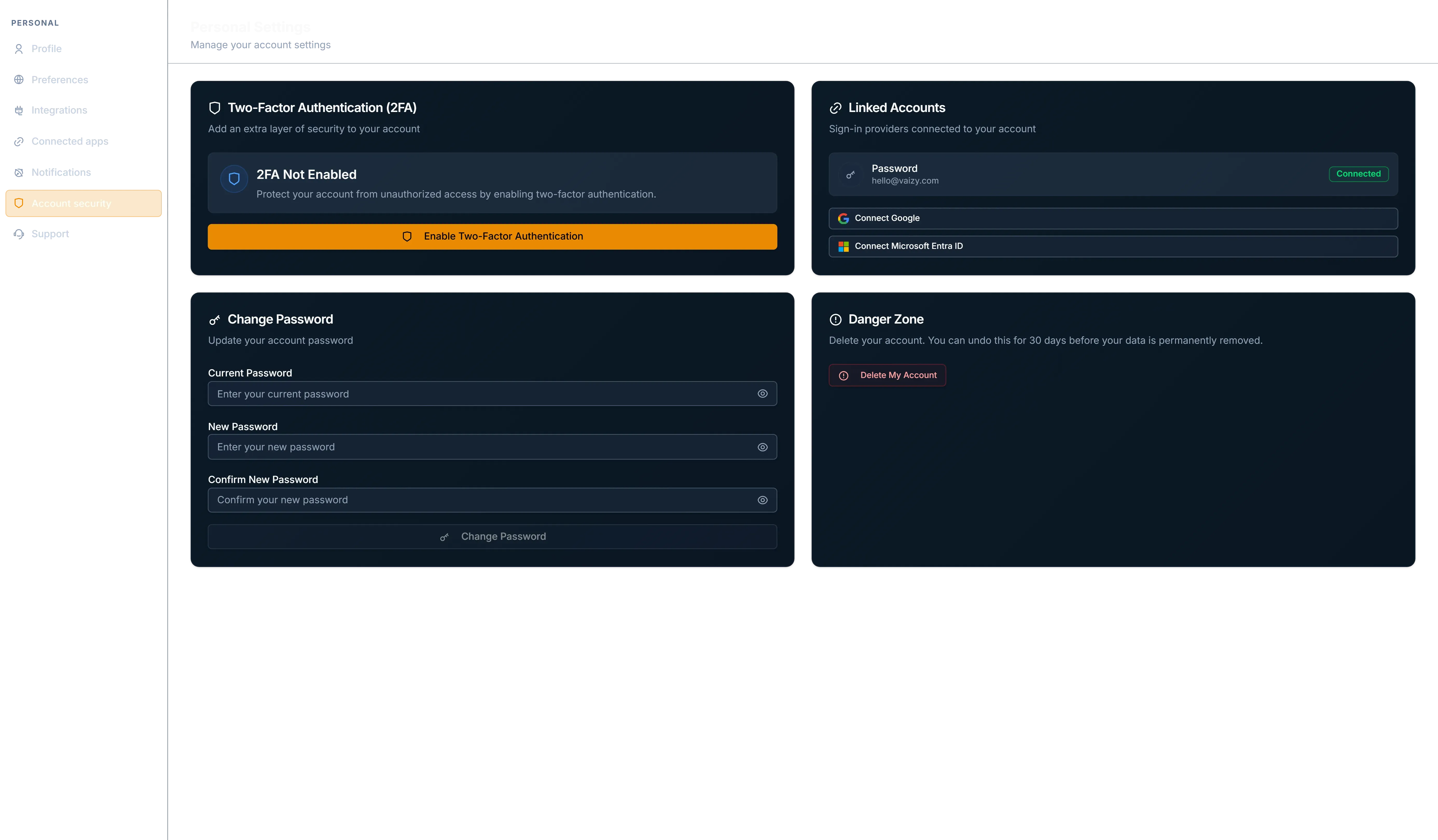
Authentication
Vaizy supports:
- Email and password login.
- Sign in with Google or Microsoft (Entra ID).
- Time-based two-factor authentication.
- Secure password reset and invite flows.
- Confirmation wrappers for auth links, so automated email scanners do not consume tokens before the user continues.
- Token verification happens server-side, so even if a scanner visits the confirmation link, the token is not consumed until the real user continues.
- If you're signed out unexpectedly — for example because you signed in elsewhere or your session timed out from inactivity — the login page tells you why, instead of just returning you to a blank sign-in form.
- Signing in, whether by email, Google, Microsoft, or two-factor verification, no longer briefly flashes the wrong screen before landing you on your dashboard or onboarding flow. Sign-in and sign-up pages no longer flash white before their background finishes loading, either.
Passwords must be at least 12 characters. This applies to signup, password reset, and change-password flows. Existing passwords are unaffected until the next change.
If your account has MFA turned on, resetting your password asks for your authenticator code first.
Enable two-factor authentication in Settings > Security.
Data isolation
Project data is stored in PostgreSQL with Row Level Security policies. Users can only query records they own or records they have explicitly been granted access to.
Project shares use a pending/accept model. A pending invitation does not grant access.
Profile pictures and workspace images are private too. Only people you work with can see your picture, and only people who can see a workspace can see its image.
API protection
Production API routes enforce authenticated sessions and additional checks for sensitive operations.
When an API error occurs, the response includes a short reference code (e.g. VZY-AUTH-a3f9). If you contact support, share this code so the team can locate the exact log entry without needing to share personal data.
Audit log
Pro-plan workspaces can review a searchable audit log at Settings > Audit Log. Each entry reads as a one-line summary of what happened, shows only the fields that changed, and names the people and records involved, with a Project column so you can see where it happened. Filter by actor, date range, or project, search, and export results to CSV. Sensitive details like raw internal IDs are hidden, and email addresses are masked in both the log and the export.
The log records ownership transfers, archiving and unarchiving, member invites, disables, removals and time-off approvals, project sharing changes, and billing actions taken by Vaizy staff, with the project attached where there is one.
Account deletion and data erasure
Deleting your Vaizy account removes your database records, authentication credentials, and associated analytics data across all Vaizy systems. This satisfies the GDPR right to erasure.
If you own more than one workspace, the confirmation step lists every workspace that will be deleted along with your account, and asks you to confirm explicitly. They're all scheduled together, and if you cancel the deletion, all of them are restored. Any active subscription is cancelled first, and the deletion waits if that cancellation doesn't go through.
AI privacy
See VaizyAI for how the assistant is used. Before data is sent to the AI model, Vaizy masks or removes sensitive patterns:
- Personal names are tokenized and restored in the response.
- Emails, API keys, UUIDs, IBANs, and sensitive fields are masked or redacted.
- Bearer tokens are hard-replaced.
- Credential headers are stripped.
- A final scan can block requests if sensitive data remains.
AI calls go through a server-side gateway. Client code does not talk directly to OpenAI.
Data residency
Vaizy B.V. is a Dutch company operating within the European Union. Customer data is stored in Supabase infrastructure in the EU region, Frankfurt, Germany.
OpenAI and HubSpot are US-based subprocessors covered by European Commission Standard Contractual Clauses. Core database, authentication, and analytics infrastructure runs in EU regions.
Legal posture
Vaizy B.V. is not a US entity and does not operate customer data infrastructure under US jurisdiction. Dutch law governs the Data Processing Agreement, with competent courts in Amsterdam.
Was this helpful?
Still need help? Ask the team